
Mar
When Should I Start to Spring Transition My Lawn to Bermudagrass?
I’d like to go over some common questions I have received through the blog in the last few weeks and see if it can help others with some of the same concerns. I always encourage everyone to send over your lawn questions and I will get back to you as soon as I can.
When should I start to transition my lawn back to bermudagrass?
I always recommend starting the process slowly in March and ramping up in April so your lawn has transitioned by May. I know that was a mouth full, but the truth is it’s not a short process unless you chemically transition your lawn. In March its ideal to start to gradually lower your mowing height and remove some of the turf canopy. This is not a scalp, this is lowering the height so the bermudagrass can breathe and get some sunlight. By mid-March you should be mowing two times per week and starting to see some thinning in the ryegrass. By thinning I mean bermudagrass leaves are starting to show between the ryegrass blades. Currently there is no need to fertilize the ryegrass, its time to back off on nutrition until bermudagrass season. In early April you can lightly verticut or even lightly power rake the lawn to remove some of the ryegrass giving way to bermudagrass. The more sunlight you can get in the grass, the faster you will transition. If the ryegrass remains extremely thick and lush you can expect it to provide excessive spring shade slowing down the bermudagrass. When soil temperatures reach 64 degrees (around April 15th) go ahead and apply ammonium sulfate 21-0-0 at 5 pounds per 1000 SF to jump start your bermudagrass. Continue mowing two times per week and gradually lowering your heights until you see the bermudagrass take over.
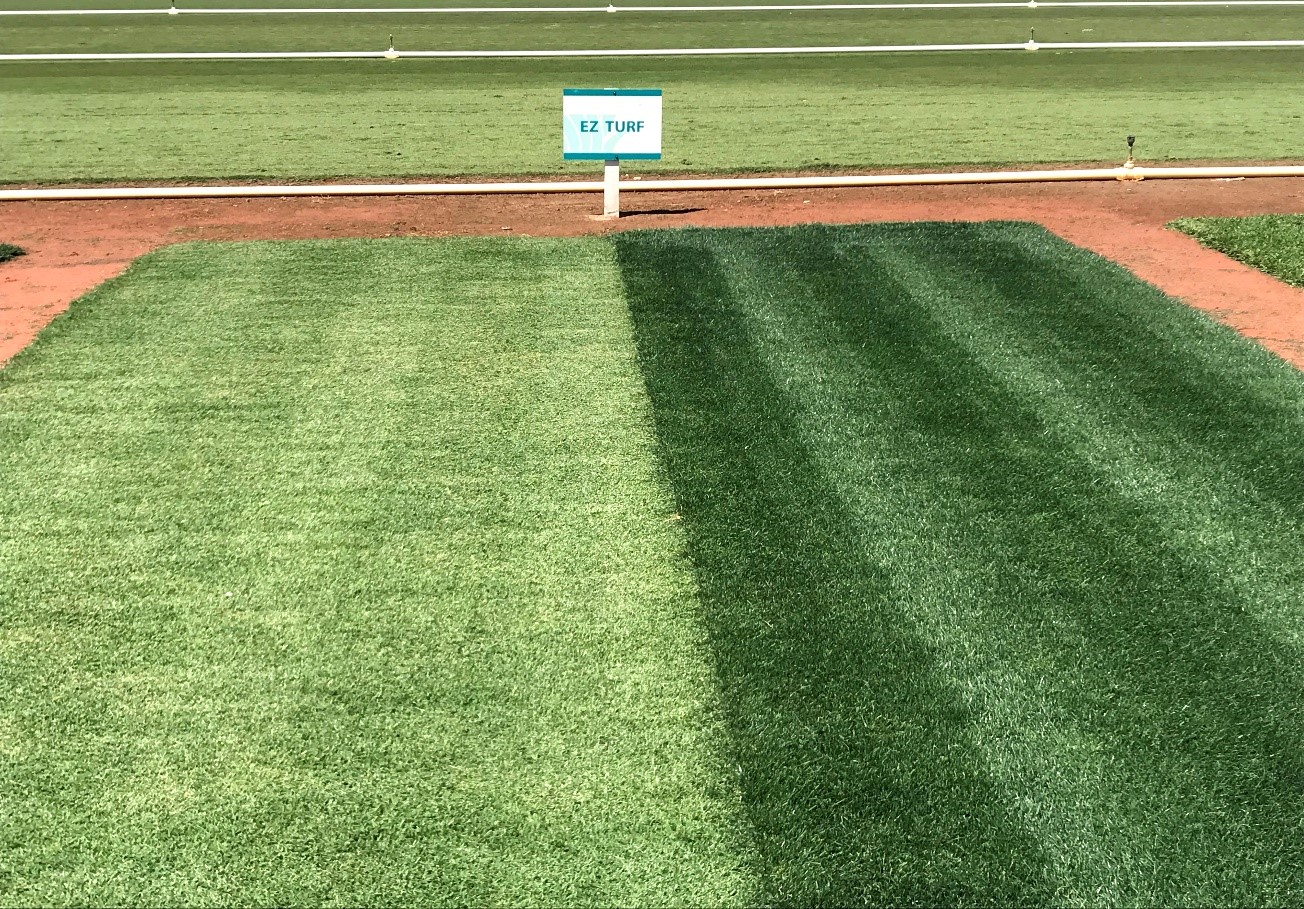
Spring Transition, keep lowering the height…..
Can I still put down pre-emergent for broadleaves?
Most of the grassy weeds and broadleaves are now germinating so putting down the preemergent will not yield the results you’re looking for. At this juncture its best to spot spray weeds depending on the type. Make sure the product is labeled for the weed you’re trying to control and can safely be used on bermudagrass. Grassy weeds use different chemicals than broadleaves and not all chemicals are safe and effective so check with specialty stores for better products.
What can I do to repair the urine damage from my dogs? Read the rest of this entry »
Comments Off on When Should I Start to Spring Transition My Lawn to Bermudagrass?
Nov
You’ve Overseeded Your Warm Season Lawn. Now What?
By now, most of you who are going to overseed your California or Arizona sod have either begun the process or have had your seed down for a few weeks. Today, I want to discuss what to do now that you have the ryegrass growing and cooler temperatures are on the horizon.
Getting your ryegrass up and growing is obviously the first step to a successful winter lawn, but what about maintenance? How can you make sure your ryegrass is strong going into the winter and you will have a full stand of ryegrass once the temperatures begin to drop into the 40’s at night? There are several key items associated with a strong winter lawn but early preparation should be high on your list.
I know you put down a starter fertilizer with your seed but let’s remember that fertilizer will move freely in a saturated soil. The new plant took up most of the nutrients from the starter fertilizer application but the residual affect is limited because you’ve been keeping the seed wet for the past few weeks. So what exactly does this mean? Basically, what I’m trying to say is that once you’ve had your ryegrass lawn in for 2-3 weeks I would advise getting a second fertilizer application on the grass.
Oct
Frequently Asked Questions About Overseeding Your Warm Season Lawn
Now that we’re into October it’s time to get the overseeding of your warm season grass process started. I wanted to pass along some of the most frequently asked questions during this time of the year.
When is the best time to start overseeding?
Ideally overseeding should be done when nighttime temperatures are consistently in the 60’s. Usually this will be in October. There will be some higher and lower than normal temperatures, but anytime during October is good.
How low do I need to scalp the grass prior to seeding?
Height of cut isn’t as important as opening the turf canopy. The shorter you mow the grass, the tighter the turf canopy will be which will result in the need to verticut more aggressively. I recommend not going lower than ½”. There is no need to take the lawn to the dirt or you will cause long term problems to the grass plant.
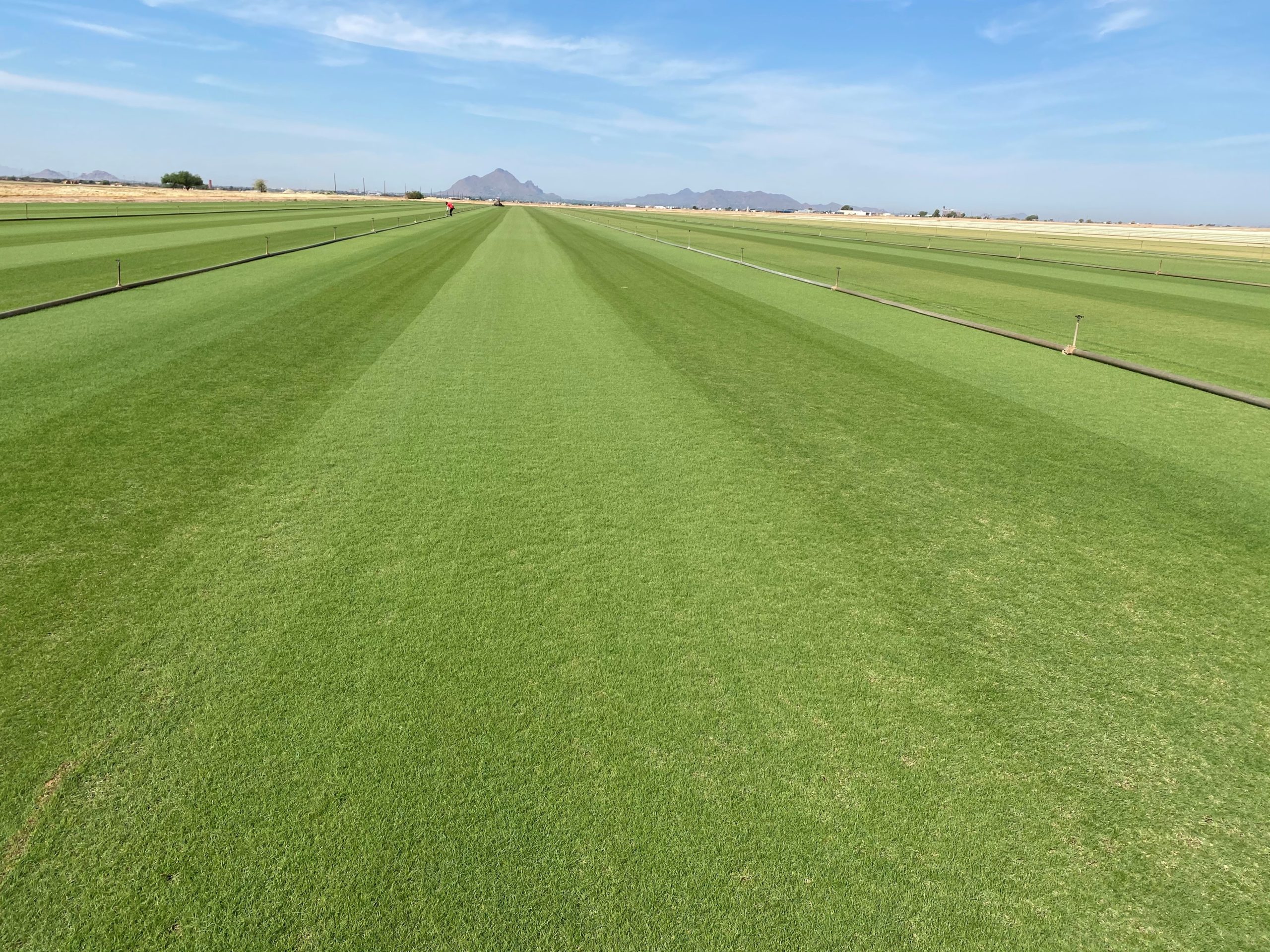
This overseeded bermuda sod field in Scottsdale, Arizona, is READY!
Aug
Late Summer Sod Tips for California and Arizona Lawns
Summer Sod Tips for California and Arizona Lawns
Summer is wrapping up, the kids are heading back to school, and I’m sure you’re ready to come out of hibernation. While the summer heat is far from over in Arizona and California, it’s going to become tolerable outside. With the slightly cooler mornings it’s time to get back outside and get your lawn ready for fall. Most people start thinking about overseeding their California and Arizona sod in September, but ideally you wouldn’t start the process until October when nighttime temperatures get into the 60’s. Between now and then there are some important steps you need to do to get your lawn ready and to save some headaches down the road.
Between May and September you’ll probably notice your lawn has grown at twice the rate it does during the winter months. Warm season grasses love the warm, wet weather. Most people thought the hot weather would keep the grass from growing well, but remember warm season grasses optimal growing temperatures are between 90-105 degrees. During this season any of your weaker areas should have filled in with the warm season grasses runners. These spots can be slow to fill in during the dry, hot days but as soon as the humidity kicks in the grass really takes off. If you still have large open spots I would suggest picking up a few rolls of sod and patching them prior to overseed. You don’t want to seed directly into the soil.

During the summer months you’re getting lots of new growth on the grass plant and you need to help it thrive. The best way to do this is to thin out the top growth by using a verticut or power rake. Most people only use one during the overseed season but it’s a vital part of promoting new growth during the summer months. When you get too much top growth the grass will get clumpy and keep your new plants from growing. A verticut or power rake will open the turf canopy and thin out the grass plant. Doing so will promote new plant growth. This will also allow you to mow your lawn shorter without scalping. Set the power rake or verticut about halfway down and run over the entire lawn. You can easily mow or rake up the material. Keep in mind that by thinning it now you will save yourself hours of labor during overseed. If you wait until overseed to thin your lawn you may need to repeat this process several times.
For the next month you don’t want to promote top growth unless you don’t plan on overseeding this fall. The more material you have, the more material you will need to remove during overseed. I like to stick to slow release nitrogen products or products that will promote root growth during late summer. There are lots blends that will work but phosphorus and potassium will help your roots at this time of the year.
It’s still too hot to really cut back your water but during the wet periods you can let the lawn stress before you turn the irrigation system back on. Let the lawn go until you see some bluish grey spots appearing in the lawn. These areas aren’t dying but they are stressed. When you see these spots you know it’s time to water again. You can start to back your water down in mid-September when the nights cool off a little more.
If you’ve had persistent weed issues during the winter months you can apply Prodiamine. One product that a lot of people use is Barricade. This must be used 7 weeks prior to overseed. Keep in mind you must wait 7 weeks after you spray this product before you overseed. For the first two weeks of overseed you will need to keep the seed a little more wet than usual so the roots of the new plant can break through the Barricade layer. If you sprayed this week it would have you overseeding in the middle of October which is perfect. The best overseeding period is typically from October 7th-October 31st. Any time you seed during this time frame you will have very little competition from the underlying warm season grass. If you go earlier be prepared for the warm season grass to come back and be actively growing while you’re watering the ryegrass seed.
One way to keep the warm season grass in check is through applications of plant growth regulators such as Trinexapacethyl. One such product that many use is Primo. This can be applied 5-7 days prior to overseeding at .5 oz/1000 SF and right after the first mowing at .35 oz/1000 SF. If you seed during the normal window in October you can skip this step unless you have a very lush, over fertilized lawn going into fall. This is not an endorsement of these products but a generic list of products you can try.
The final thing you can do is mow a little lower for the next few weeks and reduce the turf density. Right before overseed I will tell you to let the grass grow up about 30-40% prior to scalping but you have over a month until you need to worry about it.
Remember when you start to see seed in the stores you want to find a perennial ryegrass that is weed free, and has a high germination rate. Many of the products you will see will be cheap in cost and won’t provide you with a dark green lawn during overseed. I will put out overseed instructions in September as we get closer to the season.
If you have any questions, please hit the “Ask Jay” button at the top right of this page.
Till next time,
Jay
Comments Off on Late Summer Sod Tips for California and Arizona Lawns
Aug
Attention Landscape Architects! We Are Now Offering ZOOM Educational Opportunities!
These are trying times, but that doesn’t mean we have to stop learning. West Coast Turf is now offering virtual Zoom educational opportunities for landscape architects!
Include your whole office! Find out about the newest varieties including the exciting Kurapia sod natural turfgrass alternative ground cover. It’s drought tolerant, unique, versatile, and beautiful. There are some great new native grasses that look spectacular. We also can update you on our old standbys such as West Coaster Fescue, Santa Ana, Bandera Bermuda, and Tifgreen that are tried and true.
Call or e-mail us today to schedule your presentation–760/340-7301 or danielle@westcoastturf.com. The presentation takes about an hour, and we are able to answer any questions you might have on natural turfgrass varieties or Kurapia sod ground cover for your next project.
We miss you and are excited to “see” you again virtually! Contact us today!

Jan
College Football Fever
It was a busy College Football Bowl season at West Coast Turf!
We started off by grassing Chase Field in Phoenix, AZ, on December 19th for the December 26th Cheez-It Bowl, in which the TCU Frogs beat the Cal Bears in overtime.
The San Diego County Credit Union Holiday Bowl was played on West Coast Turf at the SDCCU Stadium (formerly Qualcomm Stadium) on December 31st . Northwestern Wildcats topped the Utah Utes.
The Redbox Bowl was also played on New Years Eve at Levi’s Stadium in Santa Clara, CA. The Oregon Ducks defeated the Michigan State Spartans by a single point.
The “Granddaddy of Them All,” the Rose Bowl game, was played in Pasadena on New Years Day. Rose Bowl groundskeeper, Will Schnell, said was “the best field I have ever had.” Schnell added that the day after the game the field looked as if it hadn’t even been played on. Wow.
But the field absolutely was played on. The Ohio State Buckeyes outperformed the University of Washington Huskies in Urban Meyers’ last appearance as head coach of Ohio State, and his first time at the Rose Bowl. The social media world described the turfgrass at the Rose Bowl as “a green cloud,” “the greatest patch of turf in America, capable of causing grown men weep at its green grass,” “…..there is no greener grass in America than the grass in the Rose Bowl–one of the most beautiful sights in sports,” “the Rose Bowl grass is the definition of perfect.” Shall we go on?
But it doesn’t end there.
West Coast Turf was up to an unusual challenge up at Levi’s Stadium this year. During the New Years Eve Redbox Bowl, West Coast Turf crews were hard at work harvesting a new field at their Livingston, CA, farm. It was be installed at the stadium for the College Football Playoff National Championship game to be played just a week later on January 7th between the Alabama Crimson Tide, and Clemson Tigers. But first, the Redbox Bowl game needed to be completed, and the field removed. Our turf removal crew was on standby in Santa Clara and began the removal procedure about 5:30 pm, finishing the process at 1 am. Crews worked through the night in shifts installing the new field (22 truckloads worth!) and completing the entire process in 24 hours.
The sod for the National Championship game is a specialty product that was grown on plastic out at the West Coast Turf farm. It is thick-cut, and without time to root, it is heavy enough that the natural turfgrass will remain in place. The Levi’s Stadium staff was very pleased with the process, and amazed it went so quickly and seamlessly!
After the field was installed, the tailgate areas and some of the streets around Levi’s Stadium were sodded for fan enjoyment.
West Coast Turf is your leader in Arizona & California Sod.
Comments Off on College Football FeverSep
Winter Overseeding Your California and Arizona Sod Lawn
We often see overseeding your warm season California or Arizona sod lawn as a process that should be done in a weekend. For some this may be the most convenient way to prep but for others its okay to take a week or two to complete the process. Trying to knock it all out in one weekend can result in some really long days out in the heat. My suggestion is to slowly start the process now so in a couple weeks when the overseed window opens you’re ready to go and won’t be wasting your entire Saturday on the lawn. Remember that the ideal window is when nighttime temperatures are in the 60’s. We’re currently sitting in the high 70’s so I would expect a couple more weeks. To follow overseed instructions scroll to bottom of this blog.
Prepping for overseed is often a large ordeal, but starting the process gradually can eliminate a lot of headaches. I want to reiterate something I have said for the past few years. The height of the grass is not associated with a quality overseed. In other words, scalping the grass down to the dirt does not guarantee good results, but opening up the turf canopy does. The shorter you mow your lawn the tighter the leaf blades become making it harder to get the ryegrass seed into the plant. If the seed is lying on the surface it will be slow to germinate and much of the seed will be lost. The seed needs a base to grow out of, and getting inside the grass plant allows for perfect moisture, heat, and a solid growing medium. This is why it’s so important to have a good warm season grass base. If you have a new lawn or a weak summer lawn it can have a direct impact on your overseed. The seed will establish much faster inside a healthy grass stand than it will on bare dirt.
Comments Off on Winter Overseeding Your California and Arizona Sod Lawn
Sep
Pre-Overseeding Tips for Your Lawn
I would like to start by congratulating everyone on making through another California and Arizona summer. I know we still have a couple months of triple digit temperatures, but the worst should be behind us at this point. As we move into September our morning temperatures will start to feel less painful, but remember your warm season grass is loving this weather–especially your California and Arizona sod. I have started to field questions regarding fall overseeding and I want to tell you to hit the brakes. Don’t just tap the brakes, slam on the brakes. You will see ryegrass hit the stores in the next week but walk away or buy it and sit on it until temperatures really drop. Today I want to discuss prep for the fall, and how to get your grass ready to overseed. This won’t be a tutorial on how to overseed, but instead some pointers of what to do before you overseed.

Jan
Weeds and Your Arizona and California Lawns.
We haven’t had a very wet winter but with the recent rains we’re going to start to see the emergence of some winter annual weeds. The good news is the weeds that are starting to emerge are easy to control.
There are some types such as annual bluegrass, crabgrass, and nutsedge that are a little more complicated but timing pre-emergent herbicide applications can save you a lot of headaches with weed control. In this blog I will go over various weeds and some ways to control them as well as discuss herbicide timing. Weed control management is a function of several different factors but some of the things you can do to keep your lawn healthy are maintain the proper mowing height, not overwatering, fertilize monthly, and aerate the turf when the soil becomes compacted. These items right here can be the difference between weeds slowly emerging in your lawn and taking over your lawn. A healthy lawn will push out weeds and keep them to a minimum. If you have very few weeds emerge during the year chemical applications are usually unnecessary and weeds can be pulled by hand as they appear.
Oct
Fall California and Arizona Lawn Care
Time to Tune Up Your Turf

Fall is the perfect time to fine tune your lawn. By preparing your warm season turfgrass for dormancy and overseeding with ryegrass for the cool season, you can take the necessary steps to ensure your lawn stays green throughout the holidays and into spring. If you’ve already overseeded, or are still planning to overseed then these Arizona lawn care tips will help you make the most of your lawn this fall.
We’re filling you in on the best way to fertilize, water, mow and maintain both your cool season turf and your dormant warm season sod. Read the rest of this entry »
Comments Off on Fall California and Arizona Lawn Care

